
History and characteristics of the MPEG standards. Part 2
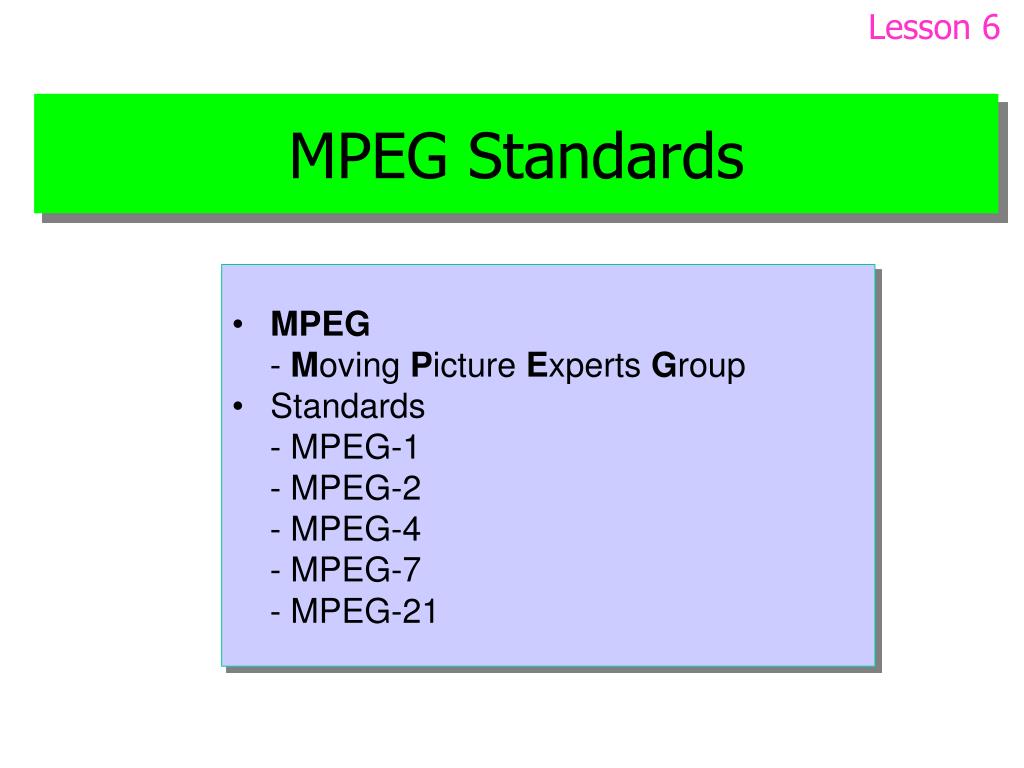
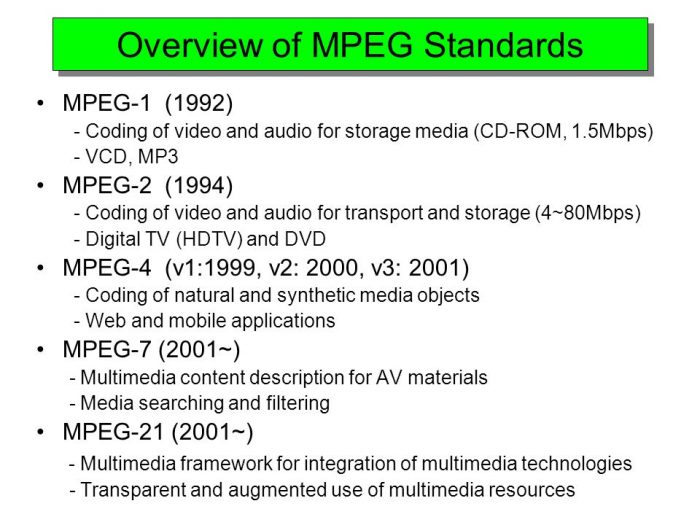
2) The MPEG-2 standard was developed especially to encode TV signals from television broadcasts, therefore, we would not have stopped considering MPEG-2 if in April 1997 this set had not received a “continuation” in the form of MPEG- 2 AAC (MPEG-2 Advanced Audio Coding – Advanced Audio Coding) algorithm.
The MPEG-2 AAC standard is a collaborative effort between the Fraunhofer Institute, Sony, NEC, and Dolby. MPEG-2 AAC is a receiver for MPEG-1 technology. There are several types of this algorithm: Homeboy AAC, AT&T a2b AAC, Liquifier AAC, Astrid / Quartex AAC, and Mayah AAC. The highest sound quality compared to MPEG-1 Layer III is provided by the two penultimate implementations. All previous versions of the AAC algorithm are not compatible with each other.
As with the standard MPEG-1 audio coding suite, the AAC algorithm is based on the analysis of psychoacoustic signals. At the same time, the AAC algorithm has many additions to its mechanism, aimed at improving the quality of the output audio signal. In particular, a different type of transformation is used, noise processing is improved, the filter bank is changed, and the way the output bit stream is recorded is improved. Furthermore, AAC allows you to store the so-called encoded audio signal in the encoded audio signal. “Watermarks”: copyright information. This information is embedded in the bit stream during encoding in such a way that it is impossible to destroy it without destroying the integrity of the audio data. This technology (under the Multimedia Protection Protocol) allows you to control the distribution of audio data (which, by the way, is an obstacle to the distribution of the algorithm itself and the files created with it). It should be noted that the AAC algorithm is not backward compatible (NBC – not backward compatible) with MPEG-1 levels, even though it is a continuation (refinement) of MPEG-1 Layer I, II, III.
MPEG-2 AAC provides three different encoding profiles: Main, LC (Low Complexity), and SSR (Scalable Sample Rate). Depending on the profile used during encoding, the encoding time and the quality of the resulting digital stream change. The main main profile provides the highest sound quality (at the slowest compression rate). This is due to the fact that the main profile includes all the mechanisms for analyzing and processing the input stream. The LC profile is simplified, which affects the sound quality of the resulting stream, greatly affects the compression rate, and more importantly, the decompression. The SSR profile is also a simplified version of the main profile.
Speaking of sound quality, we can say that the 96 Kbps AAC (main) transmission provides the same sound quality as the 128 Kbps MPEG-1 Layer III transmission. With 128 Kbps AAC compression, the sound quality is notably superior. to MPEG-1 Layer III 128 Kbps.


