
History and characteristics of the MPEG standards.
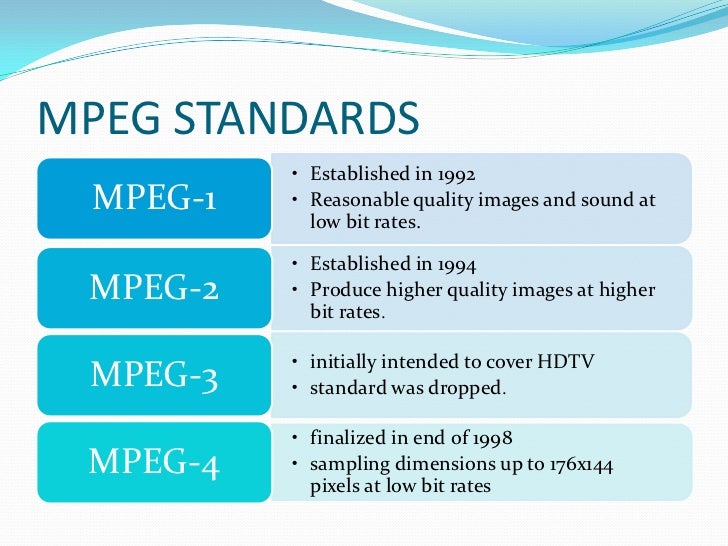
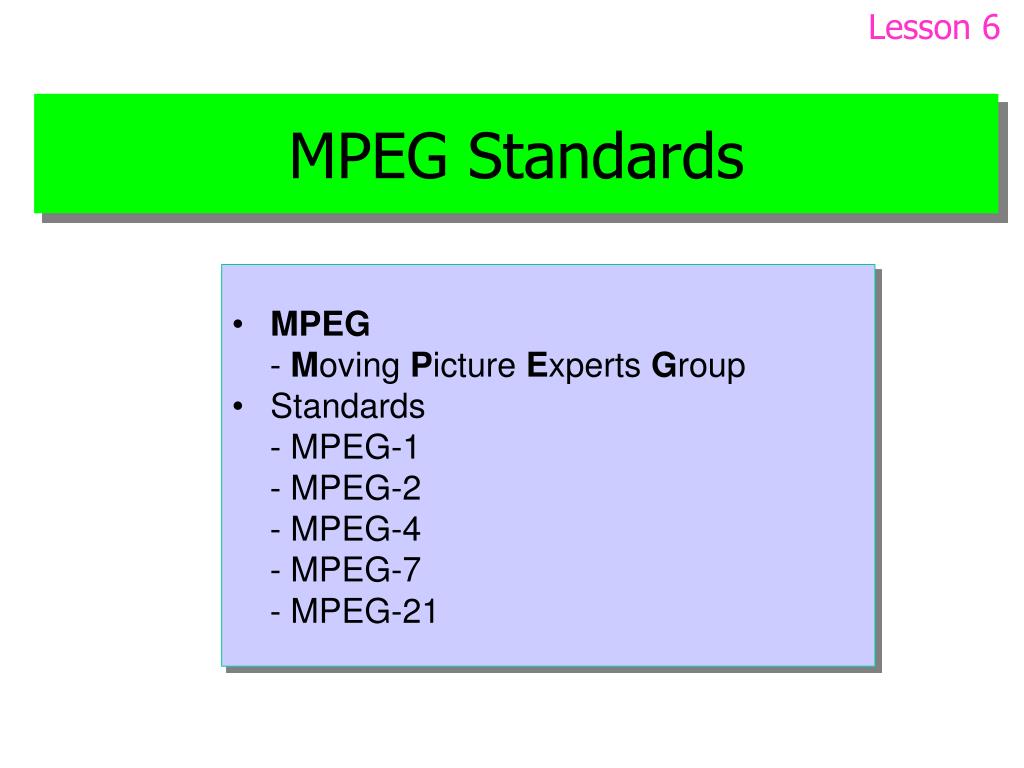
MPEG stands for Moving Picture Coding Experts Group, literally Moving Picture Coding Experts Group. MPEG dates back to January 1988. More precisely, the MPEG group was created by the International Organization for Standardization (ISO) and the International Electrotechnical Commission (IEC).
The group was formed to create standards for encoding moving images and audio information. Starting from the first meeting in May 1988, the group began to grow and became a community of high-level professionals. Typically, an MPEG meeting is attended by about 350 professionals from more than 200 companies. Meetings are held about three times a year. Most MPEG members are individual specialists employed in various scientific and academic institutions. This is from the field of history. Now about practice. To date, MPEG has developed the following standards and algorithms:
MPEG-1 (November 1992): a standard for encoding, storing, and decoding moving images and audio information;
MPEG-2 (November 1994): coding standard for digital television;
MPEG-4 – standard for multimedia applications: version 1 (October 1998) and version 2 (December 1999);
MPEG-7 is a universal standard for working with multimedia information, designed to process, filter and manage multimedia information.
In order.
1) Consider the MPEG-1 packet. This kit, according to ISO standards, includes three algorithms of various levels of complexity: Layer I, Layer II and Layer III. The general structure of the coding process is the same for all levels. Each level has its own bitstream recording format and its own decoding algorithm. MPEG algorithms are generally based on the studied properties of the perception of sound signals by the human hearing aid (ie the encoding is done using the so-called “psychoacoustic model”).
Briefly about the encoding algorithm. The input digital signal is first broken down into frequency components of the spectrum. This spectrum is then cleaned of obviously inaudible components – low-frequency noise and the highest harmonics – that is, it really gets filtered out. In the next stage, a much more complex psychoacoustic analysis of the audible frequency spectrum is performed. This is done, among other things, to identify and eliminate “masked” frequencies (frequencies that are not perceived by the hearing aid due to being dampened by other frequencies). After all these manipulations, more than half of the information is excluded from the digital audio signal. Then, depending on the level of complexity of the algorithm used, a predictability analysis of the signal can also be performed. Also, based on the combined stereo (joint stereo) fact. This means that the high and low frequencies are in fact separated and encoded in mono (the mids remain in stereo). Also, if, for example, “silence” appears on one of the channels, the “empty” space is filled with information that increases the quality of the other channel or simply does not fit before. To top it off, the ready-to-use bit stream is compressed using a simplified analog of the Huffman algorithm, which also significantly reduces the volume occupied by the stream.
The MPEG-1 kit is designed to encode digitized signals with a sampling frequency of 32, 44.1 and 48 kHz. As stated above, the MPEG-1 suite has three layers (Layer I, II and III). These levels differ in the compression ratio provided and the sound quality of the resulting transmissions. Layer I allows the storage of 44.1 kHz / 16-bit signals without significant loss of quality at a transmission rate of 384 kbps, which is 4 times gain in occupied space; Layer II provides the same quality at 194 kbps and Layer III at 128 (or 112). The Layer III gain is obvious, but the compression rate when used is the lowest (it should be noted that this limitation is no longer noticeable at modern processor speeds). In fact, Layer III allows you to compress information 10 to 12 times without any loss of quality.


