
Frequently asked questions about audio formats
The rapid development of computer technology and the Internet has led to the need to create digital formats that could be stored and reproduced on computers without the use of any physical medium. As a result, various types of digital audio formats have been developed.
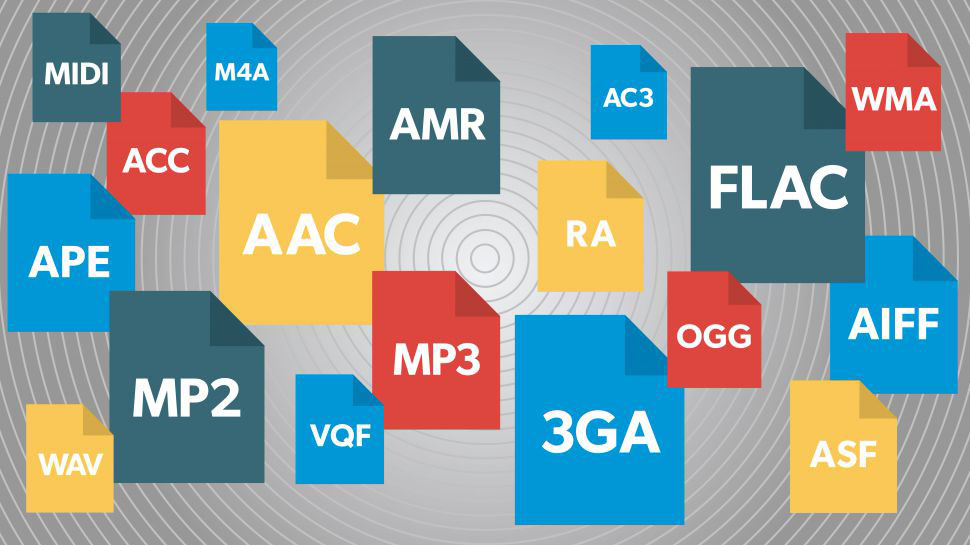
Types of digital audio formats
All digital audio formats can be divided into 3 groups according to the principle (codec) used to compress audio data, namely:
Lossy formats
These are audio formats that use a lossy compression method for audio data. That is, when encoding a digital audio recording with any of the lossy codecs, certain changes are made to the audio data. This can significantly reduce the size of the resulting file, but at the same time leads to a deterioration in sound quality. The most popular lossy formats include MP3, WMA, Ogg Vorbis, AAC, and others.
Advantages and disadvantages of lossy audio formats
The main advantage of lossy formats is the small file size, while maintaining acceptable quality for listening. Furthermore, these audio formats are compatible with the vast majority of electronic devices and music players, including home audio systems, radio recorders, and MP3 players.
The main drawback is the loss of sound quality compared to the original. If you convert an audio recording from an original licensed audio CD to a lossy format, when you play the resulting file, the sound will be worse than that of the source.
Lossy formats sound bad?
No way. First, when lossy encoding, there is a choice of compression ratio and sound quality. For example, if we are talking about the MP3 format, then to record a voice (audiobooks, audio tracks for a textbook in a foreign language), the CBR 128 kbps quality will be enough, but for music, the ideal option is CBR 320 kbps. It is worth noting that CBR is short for ConstantBit Rate, which stands for Constant Bitrate.
Second, the compression process uses the principle of removing from the recording those frequencies and sounds that a person cannot hear by nature. There is an opinion, confirmed by many experiments, that music compositions in high quality MP3 format (CBR 320 kbps) cannot be distinguished by ear from the original recording or from a licensed audio CD purchased from a store.
Lossless audio format
This is a type of digital audio format in which the audio data is encoded without loss of quality. The sound will not differ from the source in any way, be it a licensed music CD (CDA format) or a digitized vinyl head, saved in uncompressed WAV format (for Windows) or its analog AIFF (for iOS). The most popular lossless formats are FLAC, Monkey’s Audio, ALAC, WavPack, MWA Lossless.
This makes lossless audio formats ideal for listening to music on good audio equipment. For example, in high-end home speakers or Hi-Fi systems and high-end headphones.
Advantages and disadvantages of lossless formats
The main advantage of lossless audio formats is that during encoding and decoding, the program does not remove any data from the audio stream. Because of this, when playing such files, the listener receives the original sound without disturbance.
But lossless audio formats also have a major drawback. The fact is that many devices for playing sound files do not yet support these formats. You can solve the problem by purchasing the right type of equipment, for example a portable Hi-Fi player or a media player, as well as a home audio system that supports lossless audio formats.


