
As a general rule, at higher frequencies, we get better results. But the minimum sampling rate for good quality digital audio is 44,100 Hz (or 44.1 Khz). Nysquist’s theorem will help us understand why.
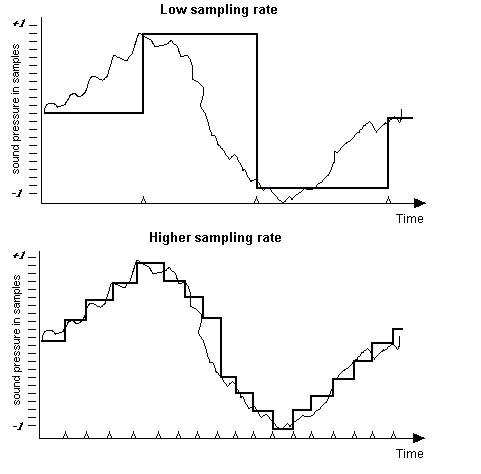
Making memory, the human ear listens from 20 Hz to 20 Khz. It is the audible spectrum. If we want to have an optimum quality audio, we must “sample” all audible frequencies, that is, the entire range. According to the mentioned theorem, for that you have to use a sampling frequency that is twice the maximum frequency to be collected. That is, to be able to record digital sounds with frequencies of 20 Khz, we will need a sampling frequency twice that: 20 Khz x 2 = 40 Khz. This is the explanation of why we use 44.1. It could be 40 Khz, but it was increased a little and 44.1 Khz was taken as standard, for the loss of samples that may be in the process.
When transmitted via online radio, lower sample rates of about 22,050 Hz are generally used. Music sounds very serious, dull. The reason is that, according to this theorem, only frequencies of up to 11 Khz can be reproduced at this sampling frequency. That is, the high frequencies that are above 11 or 12 Khz are left out.
2. Resolution (quantification)
We have just seen that to convert analog audio to digital we take a certain number of samples, but we have not yet talked about the size of these samples. Precisely, that sample size is the resolution. With higher resolution, we can save more information that will allow us to reconstruct the wave with greater fidelity.

It’s like in the cameras. The higher the number of pixels, the better quality of photos. In the first digital photographs, if you approached, what looked like a smooth face was nothing more than a square staircase. Then, the camera pixels increased and with them the definition of the photos.
The resolution is measured in bits. Although sometimes it works with 8 bits, it is best to do it with a minimum of 16 bits. With 8 bits we have 256 values for the sample (28) while with 16 bits we have 65,536 (216)
Actually, the samples we take when converting analog audio to digital are the values of electrical current in which the microphone transforms the received sounds. All these electrical values become ones and zeros and “burn”, for example, on a CD. Then, the disc reader reads those digitized values and transforms them back into current of that voltage so that the speaker moves and reproduces the sounds we record. If we have very low resolution, that is, few bits to save data, a voltage of 1,3678 millivolts (mV) will be saved as 1.3 mV. While if we have a higher resolution, for example, 16 bits, the entire figure will be saved, so the sound will be heard just like the original.
Resolution
Although in both cases there is the same number of samples, the figure on the left has less resolution,
that is why you can save smaller electrical position values such as 0.1 v or 0.3 v. On the other hand, the samples in the figure on the right, having a higher resolution, can store higher, therefore, more precise values: 0.1 and 0.15
ALIASING
These processes that are done on the computer usually add noises as too many electronic circuits come into play. To eliminate them, the audio cards incorporate filters called anti-aliasing.
Digitization is not limited to audio only. With the video it is similar. Our eyes see because all objects reflect part of the electromagnetic waves that the sun commands. These solar vibrations, instead of impacting on a diaphragm or membrane of a microphone, enter the chamber and are collected by a sensor. Its function is identical to the microphone: transform those light waves into electricity. Once you convert them to electrical values, the scanning process is the same as for an audio. Who would say we can do so many things with just zeros and ones!


