
Difference between vbr and cbr
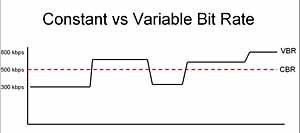
Bitrate (English): means the value (number) of bits that are used to record or transmit multimedia material that lasts one second. When multimedia content (audio and video) is fixed in MP3 format, it is compressed block by block using certain procedures (algorithms). And these algorithms are divided into types based on the bit rate (its value). Each of these blocks (frames) is assigned from thirty-two to three hundred and twenty bits.

Coding
The VBR, CBR and ABR algorithms used to encode in MP3 format do not provide complete quality preservation, it is lost. However, this can only be felt when viewing (playing) only on high-quality equipment.
For the non-professional look, material recorded with VBR, CBR, and ABR mechanisms will be of fairly high quality.
Let’s analyze the differences in the VBR, CBR and ABR algorithms to know which of them is correct to use for recording and later storage or transfer of files. Which is better for quality or for other tasks.
Constant bit rate
As the name implies (constant – constant, English), in this version of the algorithm, a constant number of bits per second of material is assigned. All blocks are equal to each other.
By using CBR it is possible to know in advance the size of the source file or the width of the sequence. This is important for transmitting information over channels with limited width.
Constant Bitrate Algorithm
Applying such encoding is not ideal:
When recording empty segments, the consumption of the selected bits remains the same;
when recording complex fragments, for which, in principle, it would be worth allocating more space, the bit rate, again, remains set.
The quality disadvantages of recording “difficult” sections are solved by increasing the bit rate, for example to a maximum of 320 kbps, but this increases the width of the transmission stream or the size of the file.
Variable bit rate
It is easy to guess that this type of method (VBR) is a variable (variable).
For such encoding, it is characteristic that the bit rate in this case changes during the encoding process by the codec program. And the bit rate in this case depends on the saturation of the audio or video material.
That is, when choosing VBR encoding, the program will select a lower bit rate to record an empty image and a higher bit rate to record saturated images or images that change quickly.
Variable bit rate algorithm
The negative aspect of this algorithm is the difficulty of anticipating the next changes. Increasing the recording bit rate will occur with a delay.
Furthermore, snippets that sound quiet are perceived during VBR encoding as unimportant snippets, and are assigned a minimum bit rate on this basis.
Therefore, CBR with a maximum of 320 kbps will provide better quality.
It is true that now VBR 2 Pass encoding has appeared.
Its essence is that the program first analyzes the multimedia stream (for the first time) and then makes a record, compressing it based on the data obtained during the primary scan. This results in the best quality and, in this sense, this encoding is better.
Average bit rate
Average is translated from English as average. This is a type of ABR, which is somehow a cross between VBR and CBR.
By choosing ABR mode, the user sets part of its value in kilobits per second. The codec can change it one way or the other, sticking to the set average value.
Average Bitrate Algorithm
The ABR method compares favorably with others in the allocated number of bits per second. You can choose absolutely any numeric parameter from 8 to 320. Whereas CBR encoding can only use sixteen times the value.
It follows from the above that if the size of the resulting file is important to the result, then for the highest quality it is better to take a close look at the ABR or CBR encoding.


