
Single Bit Audio Formats Insights
For many years, devices focused on multi-bit digital recording have dominated the field of consumer sound reproduction equipment. But it is possible that single-bit recording technology with a high sample rate will become widespread in the future.

The ghost of perfection
Today, digital audio recording and processing technologies dominate studio and consumer equipment. Due to the simplicity of editing and processing, as well as the possibility of long-term storage and multiple copying of phonograms without the slightest degradation, digital formats quickly gained the sympathy of the first professionals of the recording industry and later of the end users.
However, soon after digital devices and media almost completely drove their analog predecessors from the mass market in a relatively short time, the chorus of voices that admired the unsurpassed perfection of “crystal clear” digital sound died down. Professional musicians, recording specialists and simply connoisseurs of high-quality sound began to pay attention to the fact that, despite the stereotype imposed by a massive advertising campaign, the digital presentation of sound is by no means “perfect”.
Without a doubt, the transition to digital technologies eliminated a number of fundamental shortcomings inherent in analog recording. However, developers of digital equipment had to break their heads to solve specific problems associated with the practical implementation of the problem of converting an analog signal into digital form and vice versa. If before sound equipment designers were concerned with combating the characteristic distortions and noise inherent in analog technologies and media, then in the age of digital recording they had to look for methods to minimize errors and artifacts that arise in the process. of digitizing an analog signal and converting a digital stream to analog.
The greatest difficulties are caused by the development of modules designed to recover an analog signal from a digital recording. In general, creating a digital-to-analog converter (DAC), which could perfectly recreate the shape of the original analog signal, is an almost insoluble task. At the very least, because digital recording is discreet in nature. In the process of quantizing an analog signal, rounding of the instantaneous values of each sample inevitably occurs. Thus, we can only speak of a greater or lesser deviation of the reconstructed signal with respect to its original form, which is capable of providing a particular circuit solution.
Evolution dead end
Some experts are of the opinion that the development of digital sound recording technologies initially was not the most optimal path. Both in the field of professional and consumer equipment, the most widespread formats and devices are based on multi-bit digital recording.
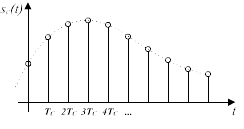
Conversion of an analog signal to this format is done using the pulse code modulation (PCM) method. In this case, the amplitude of the original analog signal is measured at regular intervals. The frequency at which these measurements are made is called the sample rate. Its numerical value must be at least twice the upper cutoff frequency of the original signal. Therefore, to digitize a phonogram with a frequency range of 20 Hz to 20 kHz, the sampling frequency must be at least 40 kHz. In practice, non-multiples are generally used: 44.1 kHz in the case of a CD and 48 kHz in the first generation DAT recorders.
The result of digitizing an analog signal using the pulse code modulation method.
For clarity, a 4-digit scale is used.
The amplitude values of the analog signal measured for each sample are rounded to the nearest integer value of the scale used. This process is called quantification. The precision of the measurement is limited both by the characteristics of the ADC and by the bit width of the digital signal or, more simply, by the number of bits allocated to record each sample. For example, in the case of 8-bit recording, the scale has 256 values, for 16-bit – 65,536, and for 24-bit – more than 16.7 million.
On the one hand, it is obvious that as the sample rate and bit depth of PCM recording increase, the conversion precision will also increase. But on the other hand, in practice, the potential to increase these parameters is limited by many objective factors, in particular the speed of the microprocessors.


