
Thanks to MP3 we can listen to our favorite music everywhere. When you put your MP3s on a USB stick, you can listen to your favorite music in the car, for example. But you can also put MP3 music on your smartphone. Allowing you to listen to music whenever possible.
But sadly, it still happens that the quality of an MP3 is not really what it should be. In this article, we look at the options to solve that problem. So that you can not only listen to music everywhere, but also enjoy it everywhere.
What exactly is an MP3 music file?
Mp3 is a method of compressing digitally stored music. Uncompressed storage of a stereo digital music file takes up a lot of disk space. An average of 10MB of disk space per minute of recorded music.
However, compressing a music file and saving it as MP3 will leave only one-tenth the size of the original file.
Since the introduction of the CD, music has been recorded digitally in the form of samples or measurements. Sound is neither more nor less than vibrating air. These vibrations are also known as sound waves. Sound waves can be measured, recorded, and stored.
However, when sound waves are produced creatively, then it is music.
The number of vibrations per second determines the pitch of the sound. A large amount of vibrations creates a high tone, a small amount of vibrations for a low tone.
The number of vibrations per second is expressed in hertz. The human ear can perceive sounds between 20 Hz and 20,000 Hz.
It was once scientifically discovered that in order to record the highest pitch, a measurement must be taken 44,100 times per second. Therefore, the number 44,100 is the sample rate in hertz that is required for good quality recording.
In addition to high and low tones, a piece of music also contains high and soft passages. The difference between the loudest and the softest passages is called the dynamic range. For the dynamic range of a piece of music to be recorded digitally, you can choose 256 steps (8-bit) between the softest part and the hardest part or 65536 steps (16-bit).
The dynamic range is highest when recording with 16-bit samples or 65536 steps.
If we then do some math with this data, we see that 44,100 measurements are needed for one second of music. Each measurement (sample) is 16 bits (2 bytes) in size. That means 1 second of music takes up 88,200 bytes or 88Kb of disk space.
But since we like to listen to music in stereo, we can multiply that number by 2. For example, one second of music in stereo takes up 176 Kb of disk space and therefore 10 MB per minute.
When a compressed MP3 file is created from an original music file, this is done using a lossy compression method.
Lossy compression causes data loss. With an MP3 file, this means that information is omitted from the file that is beyond the reach of the human ear.
Humans are most sensitive to sounds between 2 kHz and 4 kHz. And we cannot hear loud and soft sounds simultaneously. Therefore, it is only necessary to keep the loud sound. In technical terms, this is called psychoacoustic masking.
What determines the quality of an MP3?
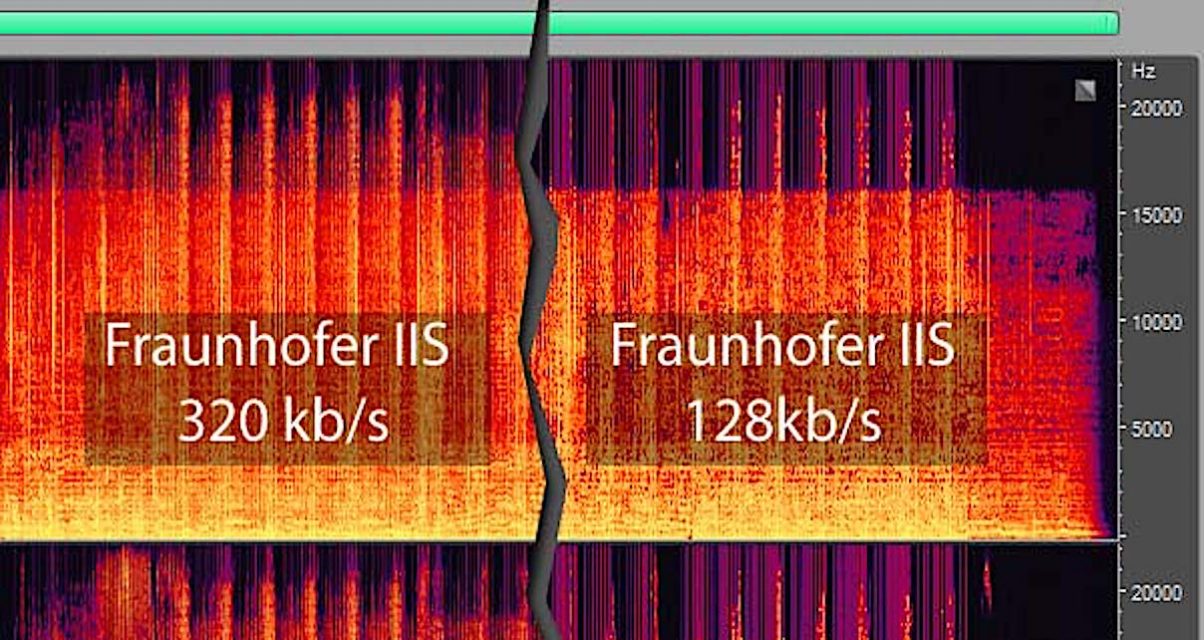
The MP3 format was developed by the German research institute Fraunhofer ISS. In addition to utilizing the limitations of human hearing just mentioned, the format consists of several mathematical formulas. This makes it possible to reduce the original file by a factor of 3 to 12.
The degree of compression is related to the bit rate. Bit rate is the amount of data that is processed per unit of time. This means, among other things, that the more data there is in one second of music, the larger the MP3 file will be. But also the better the sound quality of the MP3.
A bit rate of 64 to 96 kbps is enough to talk. A bit rate of 128 kbps is used for a good quality music file. Excellent quality can be achieved with a bit rate of 192 kbps or higher, with a maximum bit rate of 320 kbps.
A bit rate of 192 kbps or higher is only useful if the recording quality of the track is also excellent.
Obviously if you want the mp3 to sound even better, use Mp4Gain to mormalize mel volume, to correct the equalization and to make a series of changes or improvements.


